








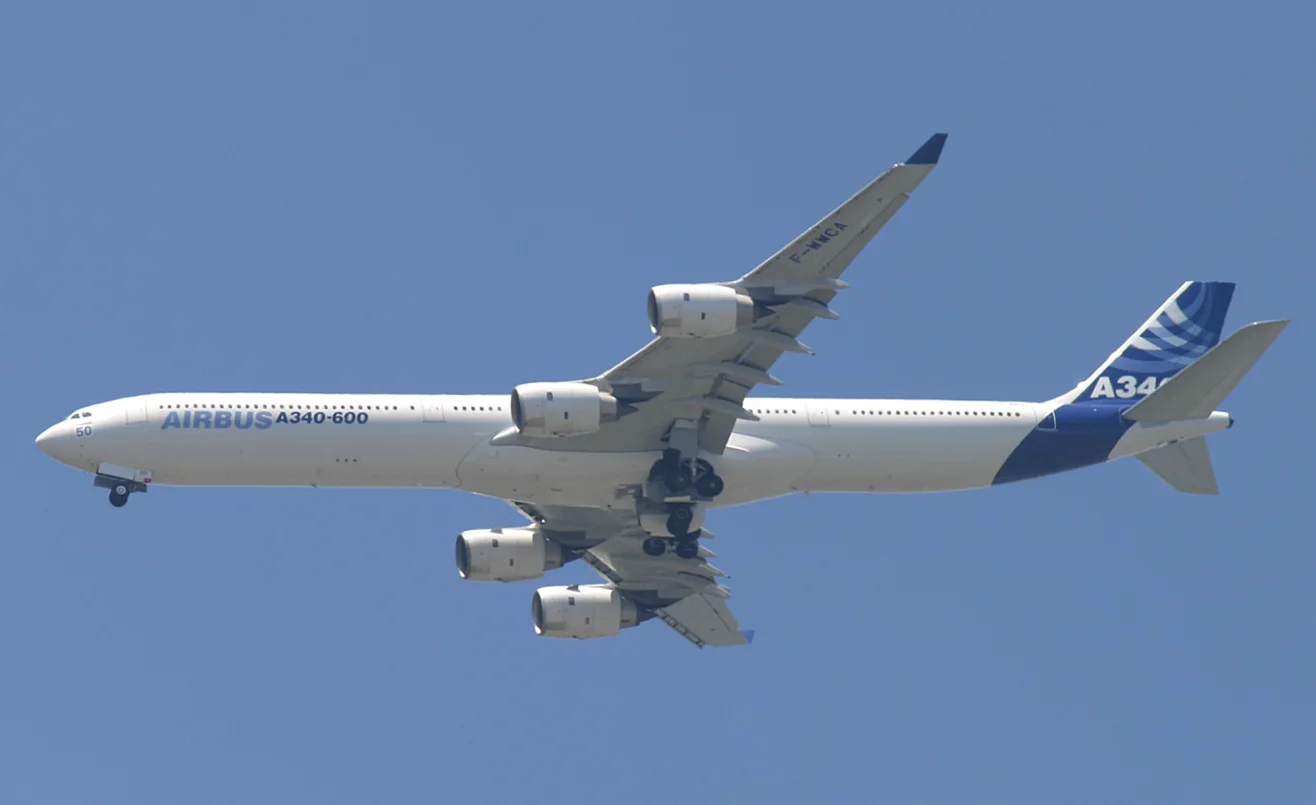
For aviation enthusiasts, few aircraft inspire the kind of fascination commanded by the Airbus A340-600. Stretching nearly 247 feet from nose to tail, the four-engine wide-body once held the distinction of being the world’s longest commercial passenger aircraft. Yet, despite its imposing presence and loyal following, the aircraft struggled to win the commercial battle against more fuel-efficient rivals.
Now, the gradual disappearance of the A340-600 is marking the end of an era in long-haul aviation. German flag carrier Lufthansa recently retired its remaining aircraft from service, drawing aviation enthusiasts from across Europe and beyond for a final opportunity to fly aboard the distinctive jetliner.
According to a report by CNN Travel, the aircraft’s final Lufthansa flight took place on October 18, when the 17-year-old jet, registered as D-AIHW, arrived at Washington Dulles International Airport ahead of its journey back to Frankfurt, Germany.
The occasion attracted a crowd of aviation enthusiasts who gathered around the airport’s windows to witness the aircraft’s arrival. Some travelled internationally for the farewell, while others wore specially made T-shirts celebrating the aircraft’s four-engine configuration and long-haul capabilities.
For many, the departure was more than the retirement of an ageing aircraft. It was a farewell to a distinctive chapter in commercial aviation, when manufacturers pursued size, range and engineering ambition in an increasingly competitive market.
When the A340-600 entered commercial service in 2002, its extraordinary length made it the longest passenger aircraft in the world, a title it held until Boeing introduced the longer 747-8 Intercontinental in 2010.
Powered by four Rolls-Royce Trent 500 engines, the aircraft was designed to transport large numbers of passengers across long distances. Its elongated fuselage and broad wings gave it an unmistakable profile, setting it apart from many of the aircraft operating alongside it.
However, its size came with operational challenges. Pilots required additional visibility aids to manoeuvre the aircraft safely on the ground, while airports had to ensure that their taxiways, runways and infrastructure could accommodate its dimensions.
In its later years, Lufthansa’s remaining A340-600s sometimes carried their own tow bars to ensure compatibility with airports that lacked suitable equipment.
The aircraft also featured an unusual interior arrangement: a lavatory located on the lower deck, below the main passenger cabin, in space typically associated with cargo. The configuration freed up room upstairs for additional seating, although it also contributed to the aircraft’s reputation for unconventional design.
These distinctive features helped establish the A340-600 as a favourite among aviation enthusiasts, even as its commercial prospects weakened.
The A340-600 was introduced at a time when airlines were seeking aircraft capable of carrying substantial passenger numbers over intercontinental routes. Airbus positioned the model as a potential replacement for older Boeing 747 aircraft, offering long-range performance and significant passenger capacity.
Several airlines, including Virgin Atlantic, Iberia, China Eastern and South African Airways, invested in the aircraft. Virgin Atlantic operated its first commercial flight with the type in 2002.
However, the market was changing rapidly. Boeing’s 777-300 and longer-range 777-300ER offered comparable capacity and long-haul capability while relying on just two engines.
That distinction became increasingly important as airlines focused on fuel consumption, maintenance costs and overall operating efficiency. With four engines to maintain and power, the A340-600 struggled to compete economically with the newer twin-engine aircraft.
Although Airbus leadership initially expressed confidence in the appeal of four-engine aircraft, airlines increasingly favoured the economics of twin-engine operations. Boeing went on to sell hundreds of its extended 777 models, while the A340-600 fleet peaked at just 95 aircraft in 2009, according to aviation analytics firm Cirium, as reported by CNN Travel.
The aircraft’s commercial limitations became more pronounced as engine technology improved, enabling twin-engine jets to undertake longer routes with lower operating costs. The shift ultimately reshaped airline fleet strategies and accelerated the retirement of many four-engine aircraft.
Despite its disappointing sales performance, the A340 family played an important role in Airbus’ development as a major global aircraft manufacturer.
The experience gained from developing and operating the aircraft contributed to the European manufacturer’s wider ambitions in long-haul aviation, including the development of the double-decker Airbus A380, which entered service in 2007.
The A340-600 itself also established a lasting identity among enthusiasts and aviation professionals. Its size, four-engine configuration and unusual engineering features made it memorable in an industry increasingly defined by efficiency and standardisation.
Its retirement from Lufthansa’s fleet follows the withdrawal of the type by several other major operators. China Eastern ended its A340-600 operations in 2015, while Iberia and Virgin Atlantic retired theirs in 2020. South African Airways followed in 2021.
A small number of aircraft remain in service, including examples operated by Venezuela’s Conviasa and Iran’s Mahan Air. Lufthansa’s final four A340-600s were placed in storage in Düsseldorf following their withdrawal, with their eventual fate still dependent on whether new operators emerge.
Lufthansa plans to replace its A340-600s with newer-generation aircraft, including the Airbus A350-1000 and Boeing 777-9. The A350-1000 is expected to offer improved fuel efficiency and modern cabin features, while the 777-9 is intended to deliver greater capacity and efficiency once it enters service.
The transition reflects a broader industry movement towards twin-engine aircraft, which have become increasingly capable of serving long-haul routes that once demanded four engines. Improvements in engine technology, aerodynamics and aircraft design have enabled airlines to reduce operating costs without sacrificing the range and passenger capacity required for international travel.
The same trend is influencing the future of other iconic four-engine aircraft, including the Airbus A380 and Boeing 747, as airlines reassess the financial and operational demands of maintaining large, fuel-intensive fleets.
For Lufthansa, the A340-600’s departure is therefore part of a wider fleet modernisation strategy. For enthusiasts, however, it represents the loss of an aircraft whose distinctive silhouette and engineering character made it unlike almost anything else in the sky.
As CNN Travel noted in its report on the aircraft’s final Lufthansa flight, the farewell was deeply emotional for passengers who had travelled considerable distances to be part of the occasion.
Although the A340-600 may never have achieved the commercial success its manufacturer envisioned, its place in aviation history remains secure. It was a striking example of engineering ambition in an era of changing airline economics, and its gradual disappearance underscores how dramatically the priorities of long-haul aviation have evolved.
This article has been adapted from a report originally published by CNN Travel.