










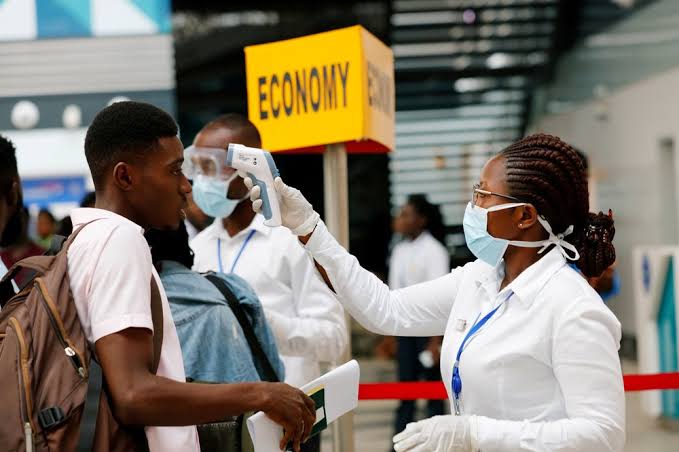
Nigeria’s confirmation of an imported case of Ebola Virus Disease (EVD) has placed the country’s aviation industry under renewed public health scrutiny, prompting tighter airport surveillance, restrictions on the air travel of identified contacts and fresh concerns about passenger confidence, regional connectivity and the preparedness of Africa’s aviation network.
The Federal Government’s response has so far focused on containing the infection, strengthening surveillance at the country’s airports and preventing possible transmission through air travel, without imposing a blanket flight ban on passengers from affected countries.
The Federal Airports Authority of Nigeria (FAAN) has heightened vigilance across airport operations, while the Minister of Aviation and Aerospace Development, Festus Keyamo, has directed the Nigeria Civil Aviation Authority (NCAA) to prevent 46 people identified as contacts of the infected patient from travelling by air for at least 21 days.
The directive followed a virtual meeting between Keyamo and the Coordinating Minister of Health and Social Welfare, Professor Muhammad Ali Pate, after Nigeria confirmed its first case of Ebola Bundibugyo virus disease since 2014. The patient, a woman with a recent travel history involving Uganda, tested positive on October 20 and is receiving medical care in isolation in Abuja.
According to Keyamo, the list comprises 44 people who came into contact with the patient at a hospital after she had developed symptoms, alongside two members of her domestic staff. The NCAA was instructed to notify domestic and international airlines of the restriction, while efforts continue to monitor the contacts and establish whether any have contracted the virus.
The measure represents a targeted intervention to limit the possibility of an exposed person travelling during the incubation period and potentially developing symptoms elsewhere. It does not amount to a general suspension of flights or a restriction on all travellers from Uganda or other countries connected to the regional outbreak.
Keyamo also directed FAAN to strengthen Ebola surveillance and response protocols across international airports, including enhanced health screening, temperature checks, travel history monitoring, digital health declarations and closer coordination with public health authorities.
The development has reinforced the strategic importance of airports as critical points of entry in national disease surveillance. Beyond facilitating passenger and cargo movement, aviation gateways are central to identifying potential public health risks associated with international travel and ensuring that suspected cases are referred promptly to the appropriate health authorities.
FAAN has said it is working with the Nigeria Centre for Disease Control and Prevention (NCDC), Port Health Services, the NCAA and other relevant agencies to support the containment effort. The authority has urged passengers, airlines, airport personnel and other stakeholders to remain calm, cooperate with health officials and rely on verified information.
The effectiveness of these measures will be important in determining whether the response remains a targeted public health intervention or develops into a more disruptive challenge for airlines and airports.
For airlines, the immediate operational priority is compliance with official directives, effective communication with aviation regulators and the ability to respond quickly to any additional screening or passenger-tracing requirements. The restriction involving identified contacts also highlights the importance of accurate passenger information and effective coordination between airlines, regulators and health agencies.
Enhanced screening can introduce additional steps into passenger processing, particularly at busy international terminals. Health declarations, temperature checks and travel-history assessments may require additional personnel, equipment and space, with the potential to lengthen queues if procedures are not adequately coordinated. Passengers may therefore need to allow additional time for airport formalities as authorities implement any further measures.
However, the extent of any disruption will depend on how the measures are implemented and whether further cases or additional restrictions emerge. There has been no announcement of a blanket suspension of international or domestic flights as part of Nigeria’s response.
The implications also extend to passenger confidence and the perception of Nigeria as an international travel destination. Public health alerts can generate anxiety among travellers, business visitors and airlines, particularly when information is incomplete or unverified. Clear communication from government agencies and timely updates on the situation will be essential to preventing unnecessary cancellations, misinformation and reputational damage.
Nigeria’s aviation sector is particularly important to the movement of business travellers, tourists, investors, government officials and cargo across West Africa and beyond. Sustained uncertainty could affect travel decisions and business engagements, although the scale of any economic impact will depend on the outbreak’s trajectory and the response of authorities.
The evolving situation in East and Central Africa has also underscored the need for coordinated surveillance across international aviation networks. Uganda, which has been linked to the recent travel history of Nigeria’s confirmed case, has denied having any active Ebola cases, saying that the woman travelled through the country without symptoms and that the location where she contracted the virus remains under investigation.
Uganda’s Ministry of Health has emphasised that transit through its territory does not establish that infection occurred there. The clarification is significant for regional aviation because a passenger’s travel route should not, in itself, be treated as proof that a particular country was the source of an infection.
The distinction matters for airlines and airports, which depend on reliable epidemiological information to guide risk assessments, passenger communication and operational decisions. Unverified claims linking a country to an outbreak could fuel unnecessary travel anxiety and undermine confidence in regional routes.
Nevertheless, the episode highlights the importance of information-sharing among countries, particularly where passengers connect through multiple airports before reaching their destinations. Investigators are working to reconstruct the patient’s travel and exposure history, while health authorities continue contact tracing.
Ghana has meanwhile intensified its preparedness at airports and other points of entry following the cases reported in Nigeria and Kenya. The country’s Ministry of Health has said no Ebola case has been reported in Ghana but is strengthening measures to prevent importation and support the early detection and management of suspected infections.
The measures include enhanced screening at Accra International Airport, simulation exercises, improved laboratory preparedness and closer coordination among the Ghana Health Service, Ghana Airports Company Limited, the Ghana Civil Aviation Authority and other partners. Travellers arriving from affected areas are also to be monitored for 21 days, while public education and the readiness of healthcare personnel are being strengthened.
Ghana’s response illustrates how the threat is prompting countries beyond those reporting confirmed infections to review their airport preparedness. For West African aviation, this regional approach is important because international travel networks connect multiple jurisdictions, making cooperation between airport operators, airlines, regulators and public health authorities essential.
At the same time, the World Health Organization (WHO) has called for sustained vigilance and stronger coordination across the region, as the wider outbreak of Ebola Bundibugyo virus disease continues to evolve. The organisation has urged countries to reinforce surveillance at points of entry, maintain rapid-response capacity, strengthen infection prevention and control, and ensure that laboratories can safely test suspected cases.
WHO has also advised against imposing general restrictions on travel or trade with affected countries. Its position underscores the need to balance public health protection with the continuity of essential transport and economic activity, using evidence-based measures rather than indiscriminate restrictions.
For Nigeria, this balance will be central to the management of the current alert. While the no-fly directive for identified contacts is designed to reduce the risk of onward transmission, broader restrictions could carry consequences for passenger movement, airline schedules, tourism, trade and international business if introduced without clear epidemiological justification.
The Federal Government has maintained that there is no evidence of community transmission in Nigeria and has expressed confidence in the country’s capacity to contain the confirmed case. Health authorities are continuing contact tracing, isolation and surveillance, while the patient’s clinical progress is being monitored.
The aviation industry’s immediate challenge is therefore to maintain safe and reliable operations while supporting the national public health response. This requires more than temperature checks alone. It depends on effective coordination among agencies, clear reporting channels, trained personnel, appropriate screening procedures and the ability to identify and manage suspected cases without creating avoidable congestion or confusion.
Nigeria’s experience with the 2014 Ebola outbreak demonstrated the value of rapid detection, coordinated emergency response and contact tracing. The current situation presents another test of those capabilities, particularly in an aviation environment shaped by high passenger mobility and extensive international connections.
Ultimately, the impact on Nigeria’s aviation sector will depend on how quickly the infection is contained, how effectively identified contacts are monitored and how confidently authorities communicate verified developments. A targeted, transparent and coordinated response could help protect public health while preserving passenger confidence and the continuity of air services.
As Nigeria and its regional partners strengthen surveillance, the priority remains clear: prevent further transmission without unnecessarily disrupting the movement of people and goods on which the region’s aviation and wider economy depend.