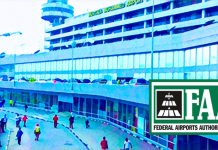







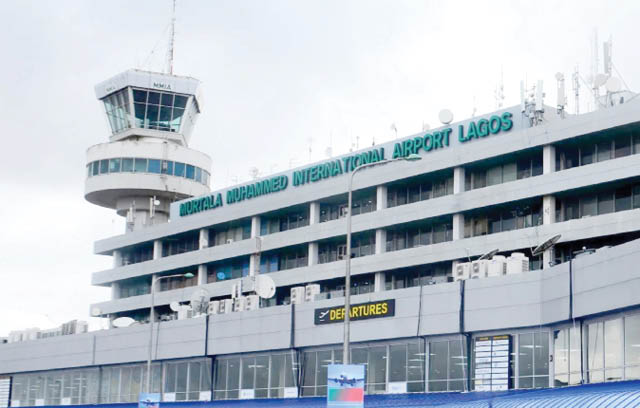
Flight operations at the temporary international terminal of the Murtala Muhammed International Airport (MMIA), Lagos, were temporarily disrupted after heavy rainfall flooded parts of the facility, forcing the Federal Airports Authority of Nigeria (FAAN) to relocate affected airlines while emergency measures were implemented.
The flooding, which affected the departure hall, boarding gates, airline offices and other operational areas, also reached the terminal’s electrical powerhouse. As a precaution against electrical hazards, airport authorities shut down power to the facility, prompting the temporary suspension of operations at the terminal.
Airlines including Air France-KLM, Ethiopian Airlines and Fly Gabon were subsequently relocated to Terminal Two (MMIA T2), allowing flight operations to continue without cancellations.
The incident comes months after FAAN closed the old international terminal for a major reconstruction project estimated at over ₦600 billion, with the temporary terminal currently handling affected international operations.
Speaking on the incident, FAAN’s Director of Public Affairs and Consumer Protection, Henry Agbebire, attributed the flooding to drainage challenges caused by ongoing construction activities around the airport rather than the intensity of the rainfall.
He explained that the flooding was localised and resulted from construction work affecting the drainage system, adding that established contingency measures were immediately activated to ensure passenger safety and minimise operational disruption.
“It was the construction works that affected the drainage. For operational reasons, we moved the affected airlines to Terminal Two, and the development did not result in any flight cancellations,” Agbebire said.
He added that the authority’s engineering teams, working alongside the project contractor, quickly addressed the drainage problem, enabling normal operations to resume shortly afterwards.
According to FAAN, passenger safety was never compromised during the incident, and flight services have since been fully restored at the temporary terminal.
The authority also disclosed that corrective measures have commenced to strengthen the airport’s drainage infrastructure and prevent similar occurrences, particularly during the peak of the rainy season.
Industry observers noted that the incident highlights the operational challenges associated with managing airport infrastructure during major reconstruction projects. While the swift relocation of airlines prevented widespread disruption, they stressed the need for improved project coordination, drainage management and infrastructure resilience at Nigeria’s busiest international gateway as redevelopment works continue.