










Keyamo gives domestic airlines December 31 deadline to adopt vPASS, warns of boarding restrictions from January 2027
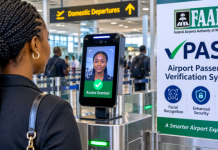
The Federal Airports Authority of Nigeria (FAAN) has unveiled a biometric passenger verification system at the Murtala Muhammed Airport, Lagos, as part of efforts to strengthen aviation security, streamline passenger processing and modernise airport operations across the country.
The Airport Passenger Verification System, known as vPASS, was launched at the airport’s Domestic Terminal by the Minister of Aviation and Aerospace Development, Festus Keyamo, alongside FAAN Managing Director, Olubunmi Kuku, and the Director-General of the Infrastructure Concession Regulatory Commission (ICRC), Jobson Ewalefoh.
Developed through a public-private partnership involving FAAN and VERXID Technologies Limited, the system is linked to the National Identification Number (NIN) database and is designed to establish a more reliable process for identifying passengers travelling on domestic flights.

Speaking at the launch, Kuku described vPASS as a unified identification platform that would make movement through airport facilities faster, safer and more efficient. She said the technology would reduce reliance on manual identity checks while improving passenger facilitation and strengthening security at designated access points.
She explained that passengers would complete a one-time registration using their NIN details and could subsequently access designated airport security gates by entering the last four digits of their identification number. At airline boarding points, verification would be conducted through biometric features, including facial and iris recognition, or by scanning the QR code on passengers’ boarding passes.
According to Kuku, registration would be available at the airport and through applications on iOS and Android devices. She said Lagos and Abuja airports were ready for the initial rollout, while the period before full implementation would allow passengers and airlines to become familiar with the system.
Keyamo said the technology was intended to address identity fraud, unauthorised access to departure lounges, airport touting and the practice of purchasing and reselling flight tickets using different identities. He added that more accurate passenger manifests would also help relevant authorities establish the identities of individuals travelling on every domestic flight.
The minister described the project as part of the Federal Government’s broader effort to modernise airport infrastructure through technology and private-sector investment. He disclosed that the Federal Executive Council approved the initiative in 2025, paving the way for its implementation.
He clarified that vPASS would initially apply only to scheduled domestic flights, as international passenger identification was already covered by a separate arrangement involving the Ministry of Interior. He also said the government would begin deployment in Lagos and Abuja before extending the infrastructure to other domestic airports.
Following the unveiling, Keyamo directed the Nigeria Civil Aviation Authority (NCAA) to ensure that all scheduled domestic airlines integrate their operations with the system by December 31, 2026. He warned that operators that fail to comply would not be permitted to board passengers from January 1, 2027.
“I am giving the airlines till the end of December. From January 1, 2027, no airline will be allowed to board passengers if they don’t key into the vPASS. All airlines, irrespective of whom, must key into it for scheduled flights,” he said.
Keyamo also assured passengers that the private-sector arrangement would not impose excessive additional costs, adding that any charge associated with the system would be minimal.
The Managing Director of VERXID Technologies Limited, Daniel Bankole, said the company’s responsibility included ensuring seamless deployment, safeguarding passengers’ personal information and complying with applicable data protection laws. He said the implementation would be monitored to provide passengers with a secure and efficient experience across the airport system.
Ewalefoh said the project had undergone the required regulatory and approval processes, including Federal Executive Council approval and vetting by the Office of the Attorney-General of the Federation. He added that the ICRC would continue to monitor compliance with the commitments and obligations established under the public-private partnership.
The launch marks a further step in the Federal Government’s plan to introduce biometric passenger verification across Nigeria’s domestic airports, with the minister’s directive setting a firm deadline for airline compliance.