










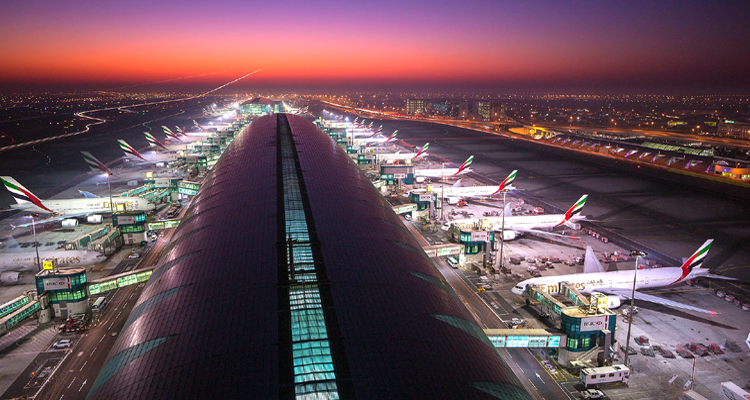
Dubai International Airport (DXB) handled 50.4 million passengers in the first nine months of 2026, maintaining its position as a major global aviation hub despite a significant decline in traffic following operational disruptions earlier in the year.
The airport recorded 18.8 million passengers in the third quarter, with August emerging as its busiest month, accounting for 6.6 million travellers. However, passenger traffic for the nine months to September fell by 28.1 per cent year-on-year, while third-quarter volumes declined by 22.1 per cent.
Despite the contraction, passenger flows remained broadly balanced between direct and connecting travellers, reinforcing DXB’s dual role as an international gateway to Dubai and a major transit hub. In September, passengers travelling directly to and from the emirate accounted for 49 per cent of traffic, while connecting passengers represented 51 per cent. The airport typically records a higher proportion of direct travellers during the winter season, when Dubai’s tourism and events calendar attracts more international visitors.
Dubai Airports Chief Executive Officer, Paul Griffiths, said the airport expects to welcome more than 70 million passengers by the end of the year as airlines restore services and its international network strengthens.
He said the airport was prioritising technology and operational improvements to accommodate future growth, simplify passenger journeys and increase capacity without necessarily expanding its existing infrastructure.
DXB is currently connected to 235 airport destinations across 101 countries through 57 airlines. British Airways resumed services during the reporting period, joining other returning carriers, including Royal Air Maroc, SunExpress and Cebu Pacific, while additional airlines are expected to restore operations in the coming weeks.
India remained the airport’s largest country market in the third quarter, generating 2.6 million passengers. Saudi Arabia followed with 1.4 million, while the United Kingdom accounted for 1.3 million. Other significant markets included Pakistan with 800,000 passengers, the United States with 640,000 and Germany with 480,000.
London was the leading city destination, recording 784,000 passengers, followed by Mumbai with 528,000, New Delhi with 525,000, Riyadh with 500,000 and Jeddah with 490,000.
Traffic also increased on several leisure routes during the quarter, reflecting demand for international