










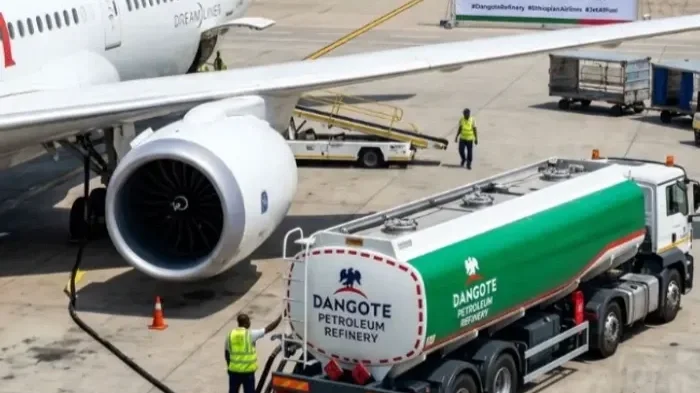
Nigeria’s aviation fuel market is witnessing a major transformation as the Dangote Petroleum Refinery strengthens domestic Jet A1 availability while simultaneously driving record export volumes to Europe, highlighting the refinery’s growing influence in both local and international markets.
The dual development underscores the refinery’s increasing role in reshaping Nigeria’s downstream petroleum sector by reducing dependence on imported aviation fuel, improving supply reliability for local airlines and positioning the country as an emerging global supplier of jet fuel.
Speaking at an industry engagement, the General Manager of Ardova Plc said the Dangote Refinery has significantly improved the availability of Jet A1 across Nigeria, easing supply constraints that had previously disrupted airline operations. He, however, noted that while supply has become more stable, pricing continues to be determined by international crude oil prices, foreign exchange movements and the cost of crude procurement.
According to him, local refining has strengthened supply security and improved product accessibility across the country, but domestic production alone cannot completely shield the market from global pricing dynamics.
The improved availability of aviation fuel is expected to enhance operational planning for airlines, reduce delays linked to fuel shortages and support increased passenger and cargo traffic, providing a stronger foundation for growth in Nigeria’s aviation sector.
At the same time, international market data show that Nigeria is rapidly emerging as a significant exporter of aviation fuel. According to S&P Global Commodity Insights, the country exported approximately 466,000 metric tonnes of jet fuel to Europe in June, almost double the 232,000 metric tonnes recorded in May and the highest monthly volume since Nigeria became a net exporter of Jet A1 in 2024 following the commencement of production at the Dangote Refinery.
The increase comes despite an oversupplied European market, where refinery output has remained high and imports from the United States and other suppliers have placed downward pressure on prices.
S&P Global noted that Nigeria has become one of Europe’s fastest-growing sources of aviation fuel, reflecting the rising production capacity of the 650,000-barrels-per-day Dangote Refinery, Africa’s largest single-train refinery.
The report showed that while the United States remained Europe’s largest supplier, its exports declined from about 818,000 metric tonnes in April to 399,000 metric tonnes in June. Nigeria, by contrast, nearly doubled its shipments over the same period, strengthening its position in the global aviation fuel trade.
The surge in exports coincided with softer international jet fuel prices. Platts, part of S&P Global Commodity Insights, assessed the Northwest Europe jet fuel cargo contract for July at $981.75 per metric tonne at the end of June, down significantly from the record highs recorded in March.
The contrasting trends illustrate the evolving dynamics of Nigeria’s aviation fuel industry. While domestic refining is improving fuel availability and enhancing energy security for local operators, pricing remains tied to global market fundamentals. Meanwhile, the refinery’s growing export footprint is creating new foreign exchange opportunities and establishing Nigeria as an increasingly important player in the international Jet A1 market.
Industry observers believe that as refining capacity continues to expand, Nigeria stands to benefit from both a more resilient domestic fuel supply chain and stronger participation in global petroleum product exports, reinforcing the country’s ambition to become a leading refining and energy hub in Africa.