








ASKY Airlines is positioning itself for a major expansion drive over the next five years, with plans to grow its network to more than 42 destinations across Africa and increase its fleet to 17 aircraft, according to the airline’s Commercial Director, Date D. Tevi-Benissan.
In an exclusive interview with Aviation Monitor, Tevi-Benissan said the Togo-based regional carrier delivered a strong performance in 2025, despite rising fuel costs, supply chain disruptions and broader global economic challenges affecting the aviation industry.
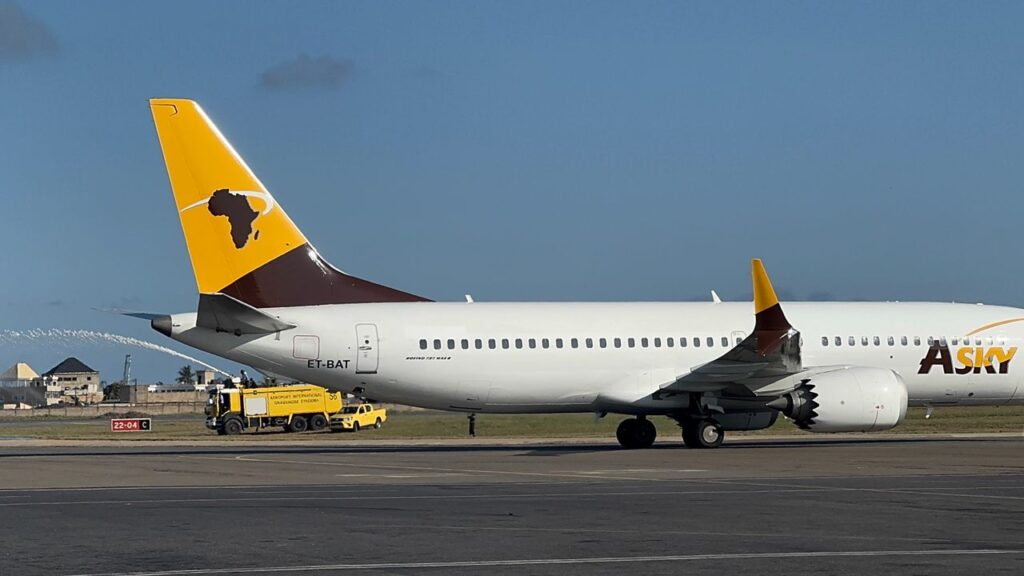
He described 2025 as a landmark year for ASKY, noting that the airline expanded its fleet to 15 modern Boeing aircraft and extended its network to 30 destinations in 27 African countries, including the successful launch of Nouakchott in Mauritania. Passenger traffic rose from 1,259,119 in 2024 to 1,319,406 in 2025, while cargo volumes also increased as additional capacity was deployed across the network.
The airline’s performance earned international recognition at the 57th African Airlines Association General Assembly, where ASKY received the Distinguished Service Award for its role in the Free Route Airspace Project and the Airline of the Year Award for Stable Financial Performance in Regional Operations.
Looking ahead, Tevi-Benissan said ASKY’s 2026 strategy focuses on strengthening connectivity by increasing frequencies on existing routes while adding new destinations that support regional integration. The airline is also investing in infrastructure, including the construction of a Boeing 737 MAX flight simulator in Lomé, which he said will reduce dependence on training facilities outside Africa and support the development of aviation professionals across the region.
ASKY is targeting more than 1.5 million passengers in 2026 and plans to take delivery of two additional Boeing 737 MAX aircraft, bringing its fleet to 17 aircraft. The airline expects the fuel-efficient MAX aircraft to play an important role in reducing operating costs as fuel prices remain elevated.
Tevi-Benissan acknowledged that the global fuel crisis has had a significant impact on African airlines, explaining that fuel costs now account for about 30 percent of ASKY’s operating expenses, compared with an average of around 15 percent previously. He noted that Africa remains one of the most expensive regions in the world for aviation fuel because many countries depend heavily on imported refined petroleum products.
To manage the pressure, the airline has focused on cost control, network optimisation, improved aircraft utilisation and fleet modernisation. He said these measures have helped ASKY maintain operational stability while preserving service quality.
On the wider African aviation industry, Tevi-Benissan argued that airlines must combine strong governance, disciplined cost management and strategic partnerships in order to survive. He praised ASKY’s partnership with Ethiopian Airlines, saying it has provided valuable operational expertise and access to financing.
He also called on African governments to treat aviation as a strategic economic enabler rather than simply a source of taxation. According to him, excessive taxes, restrictive regulations and the slow implementation of the Single African Air Transport Market continue to limit the growth of intra-African connectivity.
Tevi-Benissan said African airlines face additional challenges because revenues are collected in multiple local currencies while major operating costs, including aircraft leases, maintenance and fuel, are largely denominated in U.S. dollars or euros. He urged governments to harmonise regulations, reduce excessive charges and accelerate air transport liberalisation across the continent.
Addressing concerns about the migration of aviation professionals to Europe and the Middle East, he said ASKY is investing heavily in career development, training and workplace culture to retain talent. The planned simulator and maintenance, repair and overhaul facilities are expected to create more opportunities for pilots, engineers and other aviation professionals within Africa.
Tevi-Benissan said the airline’s long-term ambition is to become the leading regional carrier on the continent and a true Pan-African airline. By expanding its network, strengthening local aviation capacity and improving connectivity from its hub in Lomé, ASKY hopes to demonstrate that African aviation can be profitable, sustainable and a powerful driver of economic integration and development.
“In the next five years, I see ASKY as the undisputed leader of African regional aviation, a truly Pan-African airline and the pride of the continent,” he said.