










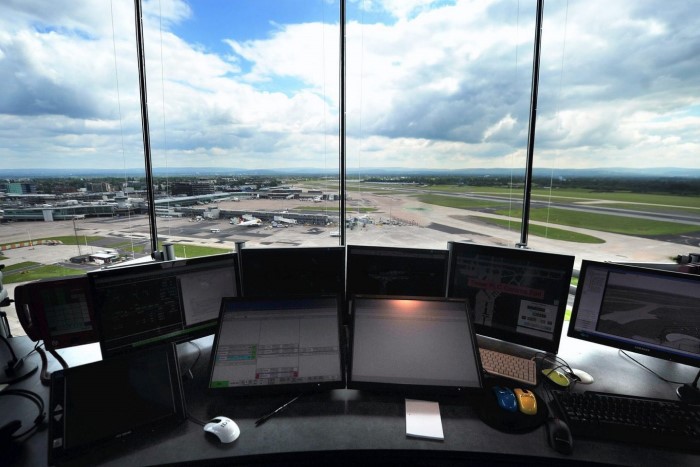
A coalition of aviation unions has called on the Federal Government to commercialise or privatise the Nigerian Airspace Management Agency (NAMA), arguing that greater private sector participation is critical to modernising the country’s air navigation infrastructure, improving operational efficiency and strengthening aviation safety.
The position was contained in a joint statement issued by the Joint Action Committee (JAC) of unions at the Nigeria Civil Aviation Authority (NCAA), comprising the Air Transport Services Senior Staff Association of Nigeria (ATSSSAN), National Association of Aircraft Pilots and Engineers (NAAPE), National Union of Air Transport Employees (NUATE) and Association of Nigerian Aviation Professionals (ANAP).
The statement was signed by the branch secretaries of the four unions—Obasi Ugwumba (ATSSSAN), Salami J. Adeniyi (ANAP), Omaga Joshua (NUATE) and Celestine N. Chukwu (NAAPE).
The unions argued that NAMA’s dependence on government budgetary allocations and statutory funding has constrained its ability to deploy critical air navigation technologies required to meet evolving global aviation standards.
According to them, adopting a commercial or public-private ownership model would enable the agency to access private equity, capital markets, international financing and bond issuances needed to invest in next-generation air traffic management systems, including satellite-based Automatic Dependent Surveillance-Broadcast (ADS-B) technology and modern backup infrastructure.
They noted that reliance on annual government appropriations, bureaucratic procedures and changing fiscal priorities often delays critical infrastructure upgrades and safety investments, while a commercially driven organisation would be better positioned to make faster operational decisions and finance long-term projects independently.
The unions cited international air navigation service providers such as Nav Canada, NATS Holdings in the United Kingdom and Airways New Zealand as successful examples of commercially structured organisations operating under user-pays models that promote financial sustainability, continuous technological advancement and high safety standards.
They also highlighted NAMA’s multiple revenue streams, including en-route and overflight charges, its statutory share of the five per cent Ticket Sales Charge (TSC), charter flight services, air traffic services, aeronautical telecommunications, calibration services, obstacle evaluation, aeronautical information sales and special Hajj operations.
However, they expressed concern over what they described as limited transparency surrounding revenues generated from airspace violation penalties and Extension of Service Hours charges, urging greater public disclosure to strengthen accountability and public confidence.
The unions also criticised NAMA’s proposal before the National Assembly seeking an increase in its share of the Ticket Sales Charge, maintaining that the agency should prioritise operational efficiency, improved financial management and institutional reforms over additional statutory funding.
They stressed that any commercialisation or privatisation framework must preserve the Nigeria Civil Aviation Authority’s independence as the country’s aviation safety regulator, with responsibility for oversight, certification, inspections and enforcement in accordance with the Civil Aviation Act and the standards of the International Civil Aviation Organization.
According to the unions, a carefully structured public-private partnership or full commercialisation, backed by clear performance benchmarks and safeguards for national security, would position Nigeria’s airspace management system for long-term sustainability, improve service delivery and ensure the country keeps pace with global developments in aviation infrastructure and technology.