









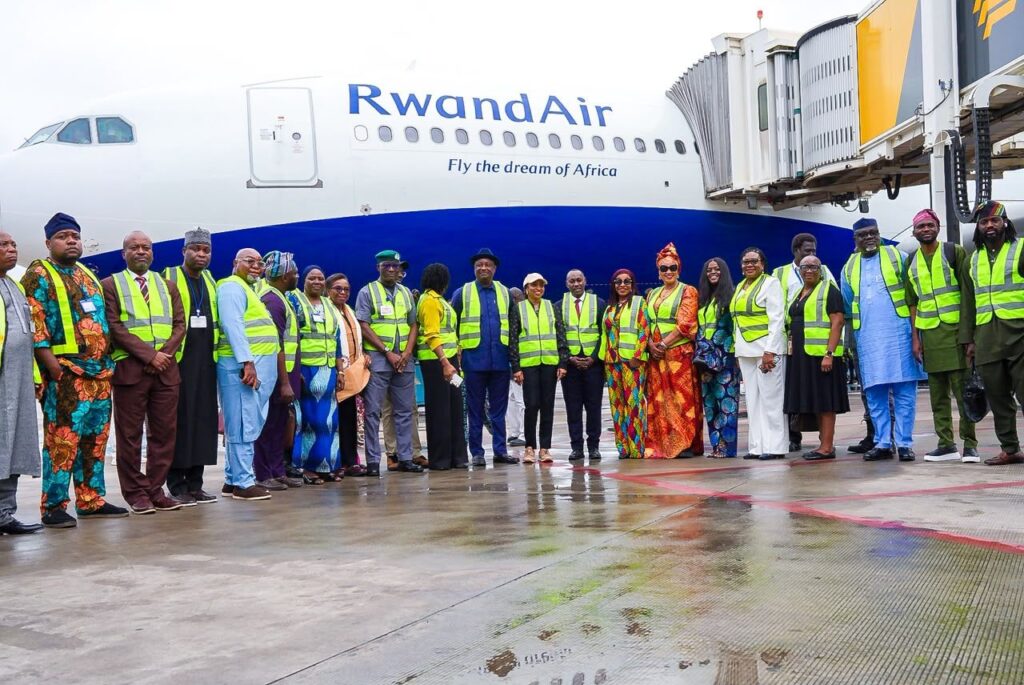
Nigeria has taken a major step toward strengthening intra-African trade with the launch of a dedicated air cargo corridor linking the country to key markets across East and Southern Africa through RwandaAir’s inaugural cargo service.
The initiative was officially flagged off by the Minister of Aviation and Aerospace Development, Festus Keyamo, alongside the Minister of Industry, Trade and Investment, Dr. Jumoke Oduwole, in a move aimed at expanding market access for Nigerian exporters and accelerating regional economic integration.
The new cargo route is expected to enhance the movement of goods across the continent, providing exporters with faster and more reliable logistics solutions while supporting the objectives of the African Continental Free Trade Area (AfCFTA). It also reinforces the Federal Government’s commitment to using aviation as a strategic tool for trade facilitation, industrial growth and economic development.
Speaking at the launch, Keyamo described the cargo corridor as a practical demonstration of how aviation can drive commerce and investment across Africa. He noted that stronger connectivity remains essential to unlocking the continent’s trade potential and creating opportunities for businesses to access new markets.
According to him, the initiative aligns with the Renewed Hope Agenda of President Bola Ahmed Tinubu and reflects the administration’s determination to strengthen economic ties across Africa through improved transportation links.
He added that meaningful growth in African trade cannot be achieved without first addressing the continent’s connectivity challenges, stressing that aviation remains a critical enabler of economic integration.
The minister further noted that the cargo service supports the goals of the Single African Air Transport Market (SAATM), which seeks to liberalise air transport services across the continent and remove barriers that have historically limited trade and mobility among African countries.
The Nigeria-East and Southern Africa cargo corridor is expected to benefit exporters in agriculture, manufacturing, pharmaceuticals and other non-oil sectors by reducing transit times and improving access to regional supply chains. Industry stakeholders believe the route will help increase trade volumes, strengthen commercial partnerships and improve the competitiveness of Nigerian products in African markets.
The launch attracted a broad spectrum of participants, including government officials, exporters, aviation stakeholders, trade representatives and RwandaAir executives, all united by a shared vision of a more connected and economically integrated continent.
With the commencement of dedicated cargo operations, Nigeria is positioning itself to play a more active role in continental trade, while creating new opportunities for businesses seeking to leverage the growing prospects offered by Africa’s expanding economic landscape.