










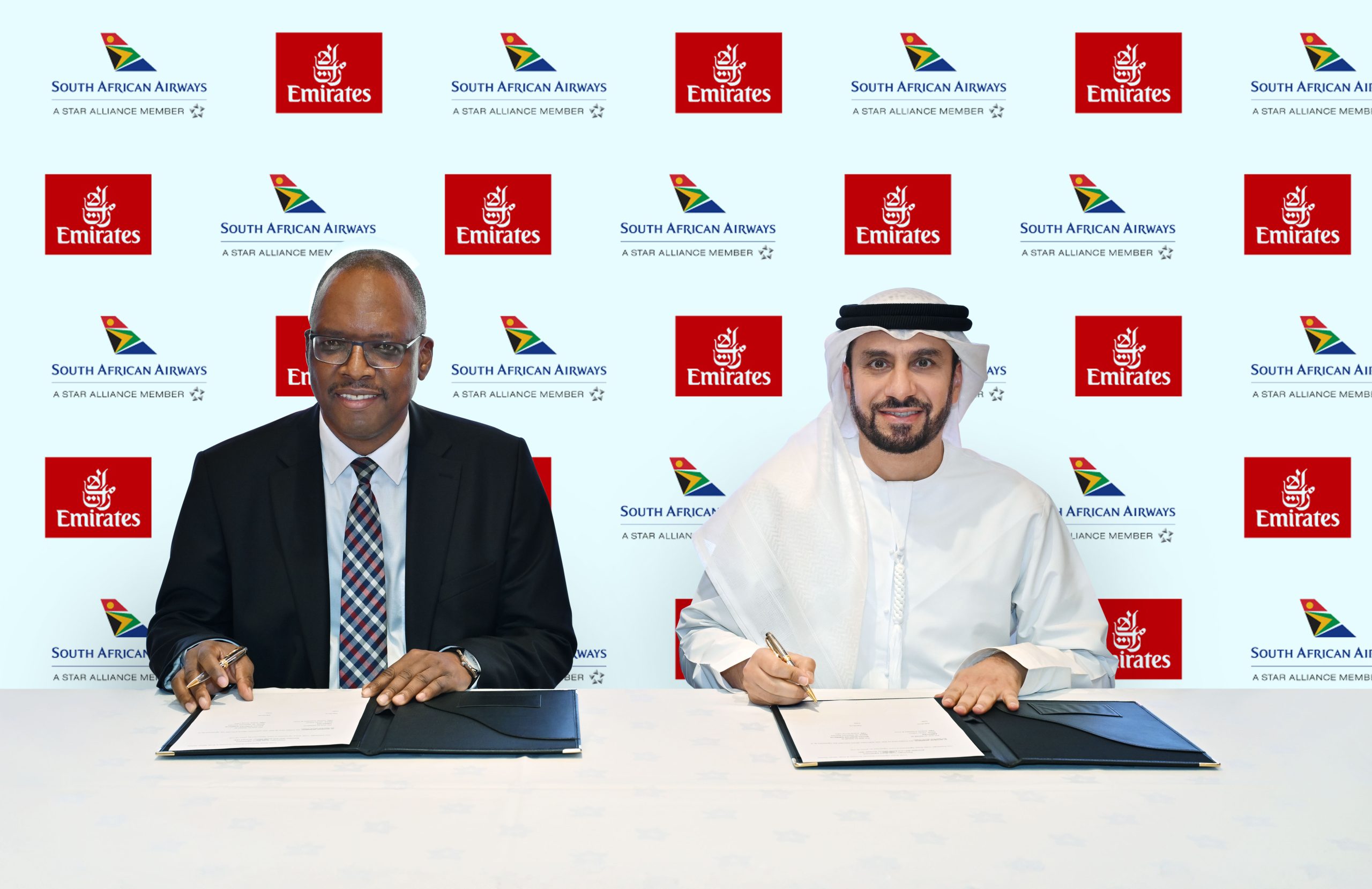
Emirates and South African Airways (SAA) have expanded their codeshare partnership to provide customers with access to nine additional destinations across South Africa and central and southern Africa, while introducing a reciprocal codeshare arrangement between the two airlines.
The expanded partnership will enable Emirates to place its code on SAA-operated domestic and regional flights, giving passengers greater connectivity beyond SAA’s Johannesburg hub and simplifying travel through a single-ticket booking experience.
Since the partnership was launched, the codeshare has operated on a unilateral basis, with SAA placing its code on Emirates-operated flights between Dubai and Johannesburg, Cape Town and Durban. The agreement also provided SAA customers with interline access to 68 Emirates destinations worldwide through Dubai.
Following regulatory approvals, Emirates will now place its code on SAA-operated flights covering nine new routes. These include three domestic South African connections linking Johannesburg with Cape Town, Durban and Port Elizabeth, as well as six regional routes connecting Johannesburg with Kinshasa in the Democratic Republic of Congo, Gaborone in Botswana, Windhoek in Namibia, Lusaka in Zambia, Harare and Victoria Falls in Zimbabwe.
The expanded codeshare builds on nearly three decades of cooperation between Emirates and SAA. Since the partnership began in 1997, millions of passengers have benefited from greater connectivity between South Africa, Dubai and destinations across Emirates’ global network.
The latest development further strengthens Emirates’ commitment to South Africa and the wider African market, providing passengers travelling to, from and within the region with more convenient connections and greater destination choice. It also comes amid sustained demand for travel to South Africa from key international markets, particularly Europe.
Adnan Kazim, Emirates Deputy President and Chief Commercial Officer, said the reciprocal codeshare represents a natural progression of a partnership that has served customers for many years.
He said placing Emirates’ code on SAA’s domestic and regional network would provide seamless access to destinations across South Africa and neighbouring countries, supported by the reliability and consistency associated with the Emirates brand.
“This reciprocal codeshare partnership with South African Airways is a natural evolution of a relationship that has served our customers well for many years,” Kazim said. “By placing our code on SAA’s domestic and regional network, we are opening up seamless access to destinations across South Africa and neighbouring countries, backed by the reliability and consistency our customers expect from Emirates.”
He added that the expansion reinforces Emirates’ long-term commitment to South Africa and the wider region, as well as its confidence in the continent’s continued growth.
Matshela Seshibe, Acting Group CEO of SAA, said the expanded partnership represents an important milestone in the airline’s strategy to strengthen connectivity across Africa while improving access to international markets.
According to him, the reciprocal codeshare will give customers a more seamless travel experience and greater choice by combining SAA’s expanding African network with Emirates’ extensive global reach.
“The partnership is about more than connecting destinations. It is about connecting people, businesses and opportunities across the continent and beyond,” Seshibe said.
He added that the partnership would create greater value for customers while reinforcing Johannesburg’s position as a key gateway for travel, trade and tourism across Africa.