








Nigerian airlines have renewed calls for a review of the country’s aviation tax and charges regime, with operators warning that multiple levies and regulatory payments are placing an unsustainable financial burden on domestic carriers.
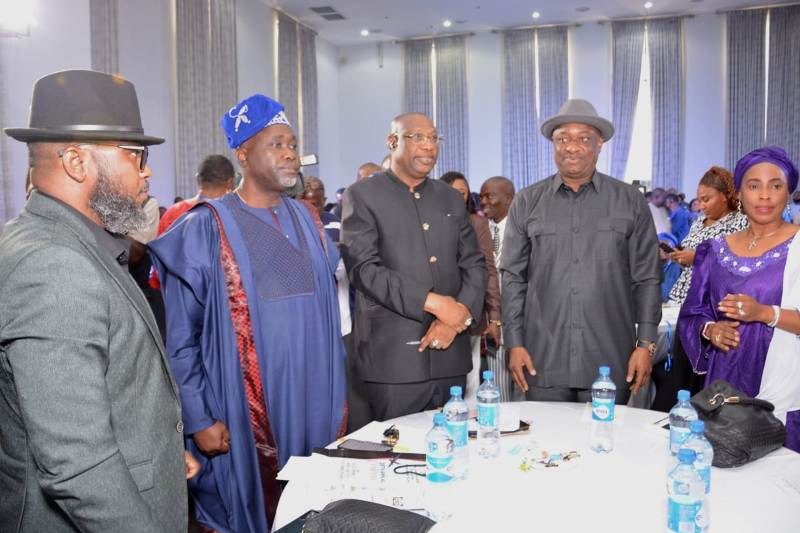
Chairman of Air Peace and Vice President of the Airline Operators of Nigeria (AON), Allen Onyema, raised the concern at the 30th Annual Conference of the League of Airport and Aviation Correspondents (LAAC) in Lagos, where he called for the harmonisation and reduction of aviation-related charges.
According to Onyema, airlines currently contend with about 54 different taxes, fees and charges imposed by major government agencies, including the Nigeria Civil Aviation Authority (NCAA), Federal Airports Authority of Nigeria (FAAN), Nigerian Airspace Management Agency (NAMA) and Nigeria Revenue Service (NRS).
He said the burden was contributing to high operating costs, limiting airline profitability and making it increasingly difficult for indigenous carriers to remain competitive.
FAAN alone, he said, collects about 18 different payments from airlines, covering services such as electricity, counter use, boarding bridges, office rent, parking, landing, cargo and terminal-related services. NAMA, meanwhile, collects charges covering en-route and terminal navigation, overflight, clearance and extension services.
The NCAA also imposes several charges, including the five per cent Ticket Sales Charge (TSC), five per cent Cargo Sales Charge, five per cent Excess Baggage Charge, licensing and medical certification fees, aircraft certification charges, Air Operator Certificate fees and maintenance organisation charges.
Onyema argued that although government agencies require funding to provide infrastructure, safety oversight and regulatory services, excessive charges could become counterproductive if they weaken the airlines from which the revenue is collected.
He said only a fraction of the charges imposed on airlines are directly incorporated into every ticket sold, but their cumulative impact eventually feeds into the cost of air travel.
Among the charges included in ticket prices are the Passenger Service Charge, Common User Terminal Equipment charge, Passenger Terminal Facility Charge, five per cent TSC, five per cent Excess Baggage Charge and the $20 NCAA security levy. He also cited the $11.50 Advanced Passenger Information System levy introduced by the NCAA in December 2025.
Onyema said the combined burden could add about N25,000 to some domestic tickets, depending on the route and airline, while taxes and statutory charges on international journeys could reach between $150 and $180.
He maintained that the objective should not be to eliminate legitimate government revenue but to create a system that allows airlines to remain viable while ensuring that aviation agencies are adequately funded.
The Air Peace chairman specifically called for a review of the five per cent TSC, proposing that it be replaced with a fixed amount attached to each ticket.
He argued that a flat charge would provide greater predictability for airlines and the NCAA while reducing the financial pressure created by applying a percentage to ticket values.
“The current system where airlines pay five per cent of the cost of each flight ticket to the NCAA is fiscally constricting the operators,” Onyema said, urging the government to adopt a structure that would support the survival of domestic carriers.
He also expressed confidence that President Bola Ahmed Tinubu could intervene if the concerns of airline operators were presented directly to him.
Onyema cited the President’s decision to exempt airlines from a four per cent Free on Board levy imposed by the Nigeria Customs Service as an example of how government intervention could protect indigenous carriers from additional financial pressure.
He said the intervention followed representations made by the Comptroller-General of Customs, Adewale Adeniyi, to the Presidency on the potential impact of the levy on airlines.
According to Onyema, the removal of the levy demonstrated the economic benefits that could arise when government policies take into account the wider contribution of airlines.
He said the aviation industry contributes about $2.5 billion annually to Nigeria’s GDP and supports more than 217,000 jobs, while its wider economic impact extends to tourism, hospitality, cargo, trade and other sectors.
The issue of charges was also addressed by AON spokesman and Chairman of United Nigeria Airlines, Prof. Obiora Okonkwo, who rejected suggestions that domestic airlines had simply refused to meet their financial obligations to the NCAA.
Okonkwo said airlines had been making payments under an agreed repayment arrangement following difficulties associated with the sharp increase in aviation fuel costs.
He said operators had met with the NCAA and Ministry of Aviation to establish a framework for settling legacy obligations, including an initial payment followed by instalments.
At United Nigeria Airlines, he said, the carrier went as far as establishing joint accounts with the NCAA to facilitate direct payment of agreed obligations.
Okonkwo nevertheless maintained that the five per cent TSC remained excessive, particularly when airlines were already paying other taxes and charges and incurring additional costs for regulatory services.
The debate comes against the backdrop of broader financial pressures facing Nigerian airlines, including expensive aviation fuel, foreign exchange challenges, aircraft maintenance costs and high borrowing rates.
Onyema warned that the continued accumulation of such costs could undermine the ability of domestic carriers to renew their fleets, expand their networks and create employment.
He argued that an airline that is forced out of business ultimately deprives government of future revenue, aviation agencies of charges, workers of employment and passengers of connectivity.
For the operators, the central issue is therefore not whether government should generate revenue from aviation, but whether the sector can be taxed and regulated in a manner that allows airlines to remain profitable and continue contributing to the wider economy.