










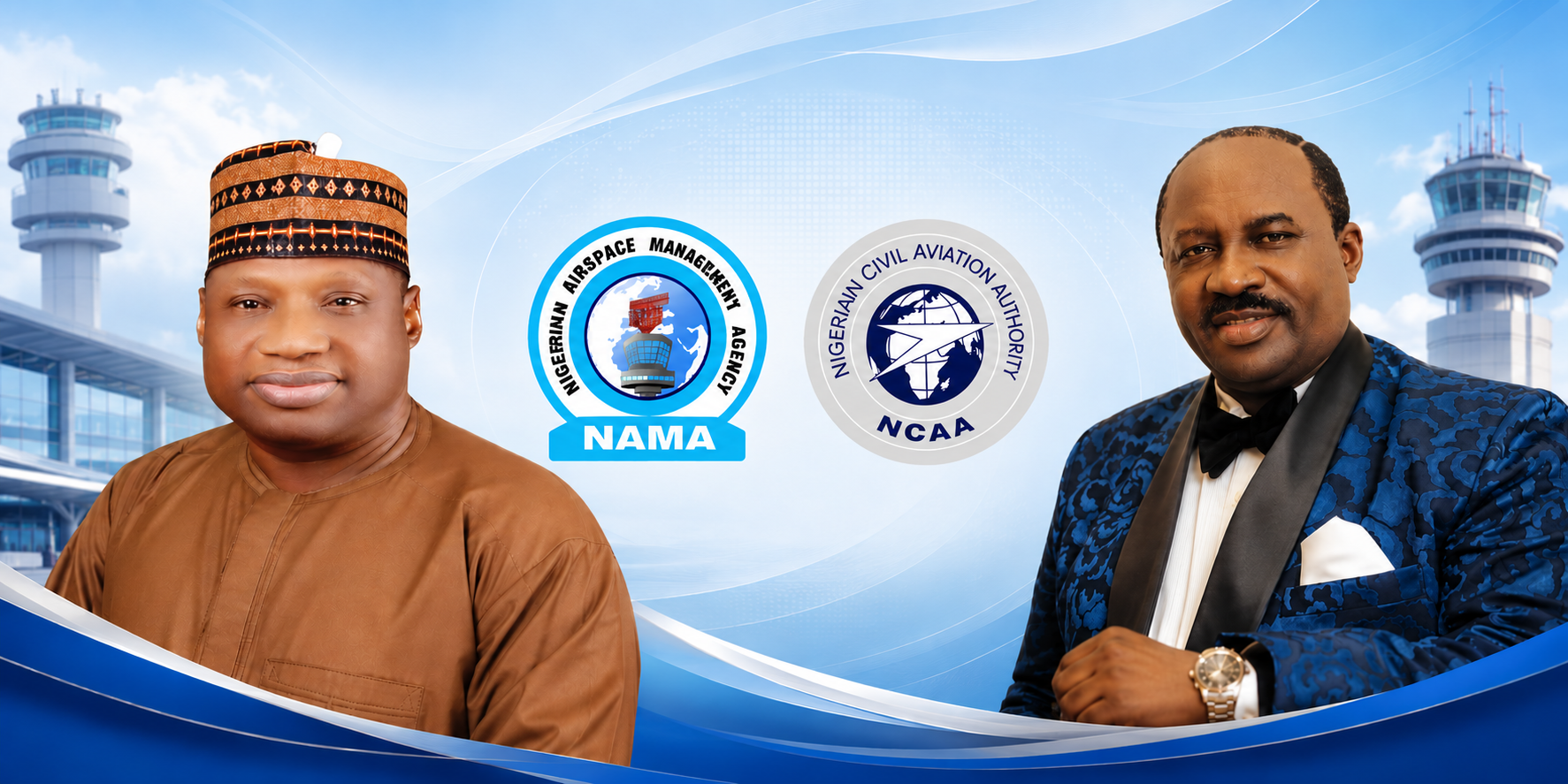
A proposal before the National Assembly to review the sharing formula for Nigeria’s statutory five per cent Ticket Sales Charge (TSC) and Cargo Sales Charge (CSC) has ignited a fresh debate within the aviation industry, with regulators, labour unions and industry stakeholders sharply divided over how the revenue should be distributed to sustain safety, infrastructure and regulatory oversight.
At the centre of the controversy is a bill seeking to revise the allocation of funds collected by the Nigeria Civil Aviation Authority (NCAA) from airlines through the statutory five per cent charge on passenger tickets and cargo operations. Under the existing formula, the NCAA receives 56 per cent of the revenue, while the Nigerian Airspace Management Agency (NAMA) gets 22 per cent, the Nigerian Meteorological Agency (NiMet) nine per cent, the Nigerian College of Aviation Technology (NCAT) seven per cent and the Nigerian Safety Investigation Bureau (NSIB) six per cent.
The proposed amendment would reduce the NCAA’s allocation to 40 per cent and increase NAMA’s share to the same level, reflecting what supporters describe as the growing financial demands of managing Nigeria’s increasingly sophisticated air navigation infrastructure.
The NCAA has opposed the proposal, warning that reducing its statutory funding could weaken its capacity to carry out safety oversight, certification, inspections and regulatory enforcement. Speaking on the issue, the Authority’s Director of Public Affairs and Consumer Protection, Michael Achimugu, argued that adequate funding remains essential for maintaining an effective safety regulatory system.
However, supporters of the amendment contend that the aviation landscape has changed significantly since the current revenue-sharing formula was introduced. They argue that NAMA now bears enormous financial responsibilities in operating and maintaining critical Communication, Navigation and Surveillance (CNS) infrastructure, including radar systems, Instrument Landing Systems (ILS), Doppler Very High Frequency Omnidirectional Range (DVOR), Distance Measuring Equipment (DME), Very High Frequency (VHF) communication facilities, Automatic Dependent Surveillance-Broadcast (ADS-B) installations and other air traffic management systems deployed across the country.
Maintaining these facilities requires continuous investment in software upgrades, equipment calibration, imported spare parts, cyber security, backup power systems and specialised technical manpower to meet the standards of the International Civil Aviation Organization (ICAO).
The proposal has also exposed divisions within organised labour. While the Joint Action Committee of unions at the NCAA argued that reducing the regulator’s allocation could undermine aviation safety, the national leadership of the National Association of Aircraft Pilots and Engineers (NAAPE) distanced itself from that position, saying it had not been approved by the union’s National Executive Council.
Meanwhile, unions within NAMA, comprising the Air Transport Services Senior Staff Association of Nigeria (ATSSSAN), the Association of Nigeria Aviation Professionals (ANAP) and the Amalgamated Union of Public Corporations, Civil Service Technical and Recreational Services Employees (AUPCTRE), insisted the debate should focus on strengthening aviation safety rather than protecting institutional interests.
The unions argued that air navigation services constitute critical national infrastructure and warned against proposals to commercialise or privatise the agency’s core operational responsibilities. Citing Article 1 of the Chicago Convention, which affirms every state’s sovereignty over its airspace, they maintained that Nigeria’s communication, navigation and surveillance systems, aeronautical databases and strategic operational infrastructure should remain under government control.
They further described the proposed increase in NAMA’s allocation as an investment in aviation safety rather than an attempt to diminish the role of any other agency, stressing that effective regulation depends on a well-funded and technically capable air navigation service provider.
Former Commandant of the Murtala Muhammed International Airport, Group Captain John Ojikutu (retd.), also called for a more balanced review of the revenue-sharing formula. He argued that the allocation should reflect objective factors such as operational responsibilities, personnel strength, nationwide infrastructure, mandatory equipment calibration and maintenance obligations rather than historical percentages that no longer correspond with current realities.
According to Ojikutu, agencies such as NAMA shoulder substantial capital and operational costs in maintaining air navigation systems, while several aviation agencies also generate revenue independently through their statutory functions. He therefore urged policymakers to adopt a rational funding framework capable of supporting long-term industry growth instead of allowing institutional rivalry to dominate the conversation.
Retired pilot and aviation stakeholder Mohammed Badamosi echoed similar concerns, noting that NAMA’s responsibilities have expanded significantly with advances in satellite navigation, automation, digital communications and performance-based navigation. He argued that sustaining these systems requires continuous investment if Nigeria is to remain compliant with international aviation standards and preserve the safety and efficiency of its airspace.
The debate has been further complicated by a separate dispute between aviation unions and domestic airlines over the remittance of Ticket Sales Charges. The National Union of Air Transport Employees (NUATE) and ATSSSAN recently issued a 14-day ultimatum to airlines, alleging that outstanding remittances running into billions of naira have reduced the resources available to aviation agencies to perform their statutory responsibilities.
As discussions continue, industry stakeholders increasingly agree that the broader issue extends beyond the allocation formula itself. They argue that the long-term sustainability of Nigeria’s aviation sector will depend on establishing a funding model that adequately supports regulatory oversight, air navigation services, training, meteorology and accident investigation while ensuring the country keeps pace with rapidly evolving global aviation technology and safety standards.

