








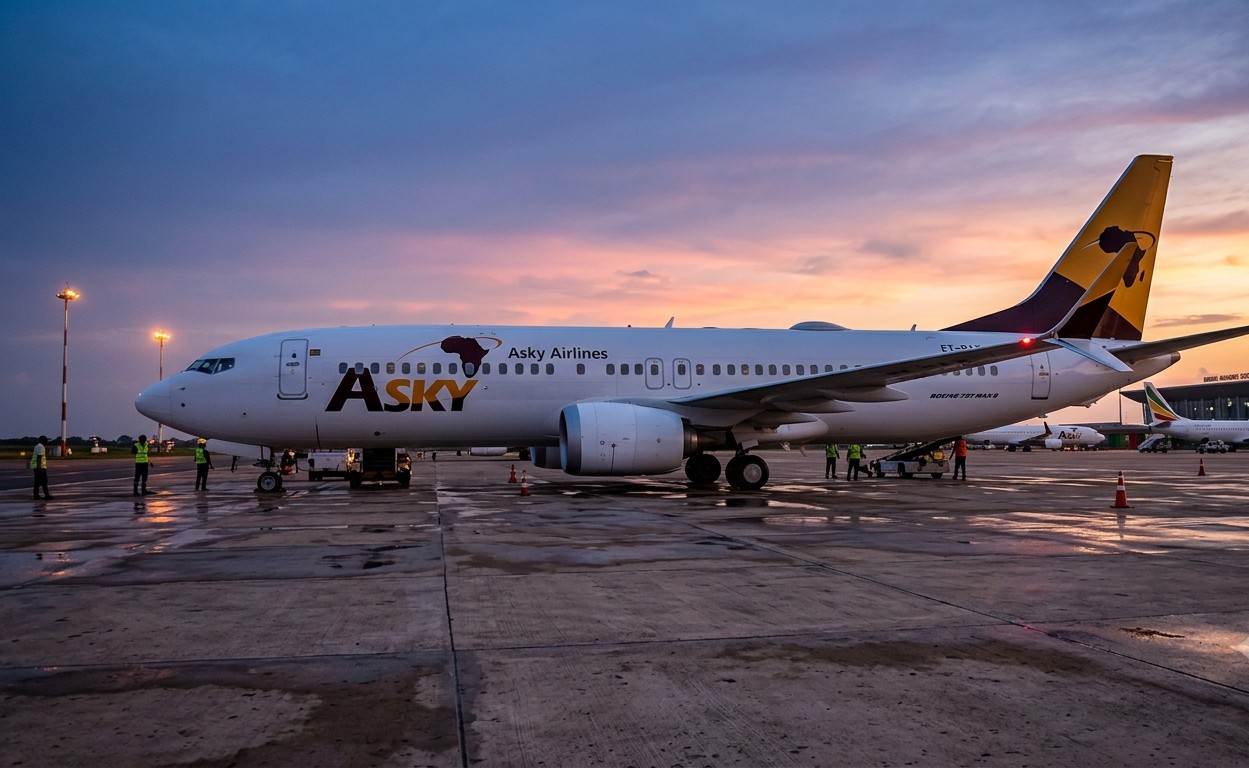
ASKY Airlines has strengthened its fleet with the delivery of another Boeing 737 MAX 8, reinforcing its expansion strategy as the pan-African carrier prepares for future long-haul operations and deeper connectivity across the continent.
The latest aircraft increases ASKY’s fleet to 16 aircraft and forms part of the airline’s ongoing fleet modernisation programme, which is focused on improving operational efficiency, lowering fuel consumption and supporting the growth of its extensive intra-African network.
Speaking on the development, the airline’s Commercial Director, Date D. Tevi-Benissan, said the new aircraft would support network expansion and increased flight frequencies across key destinations in the coming months.
He disclosed that ASKY aims to carry more than 1.5 million passengers in 2026 while expanding its fleet to 17 aircraft, with performance to be measured through financial results, operational reliability, customer satisfaction, timely aircraft deliveries and the successful rollout of its new training facilities.
Operating from its hub at Lomé–Tokoin International Airport in Togo, ASKY serves more than 30 destinations across 27 African countries, connecting major commercial centres including Lagos, Accra, Abidjan, Dakar, Bamako, Cotonou, Niamey, Ouagadougou and Kinshasa. The additional Boeing 737 MAX 8 is expected to strengthen capacity on these high-demand regional routes while improving fuel efficiency and reducing operating costs.
The aircraft, powered by CFM International LEAP-1B engines, offers lower fuel burn and carbon emissions than previous-generation Boeing 737 models while providing greater range, enabling the airline to connect more African cities with non-stop services.
Beyond expanding its narrow-body fleet, ASKY is laying the groundwork for its next phase of growth with plans to introduce Boeing 787 Dreamliners from 2027. The wide-body aircraft are expected to support the launch of the airline’s first intercontinental services, with Paris identified as the initial destination, while London and Mumbai remain under evaluation.
The planned long-haul expansion is expected to strengthen Lomé’s position as a strategic aviation hub, providing passengers from West and Central Africa with more direct access to Europe and Asia while reducing reliance on traditional transit hubs.
ASKY’s growth strategy continues to benefit from its long-standing partnership with Ethiopian Airlines, which provides technical expertise, maintenance support, fleet leasing and operational management. The collaboration has enabled the carrier to modernise its fleet while positioning it for future direct aircraft acquisitions.
The airline is also investing in aviation infrastructure to support its long-term ambitions. Construction is underway on a Boeing 737 MAX pilot simulator centre in Lomé, which will reduce dependence on overseas training facilities and strengthen regional pilot development. Plans are also progressing for a major Maintenance, Repair and Overhaul (MRO) facility, reinforcing Lomé’s ambition to become a leading aviation services hub in West Africa.
With continued investment in modern aircraft, training infrastructure and network expansion, ASKY is positioning itself as one of Africa’s fastest-growing carriers while playing an increasingly important role in improving regional connectivity and supporting the continent’s aviation development.