








The Federal Government has entered into a strategic partnership with Airbus aimed at accelerating the development of Nigeria’s aviation and aerospace sector through infrastructure support, technical expertise and workforce development.
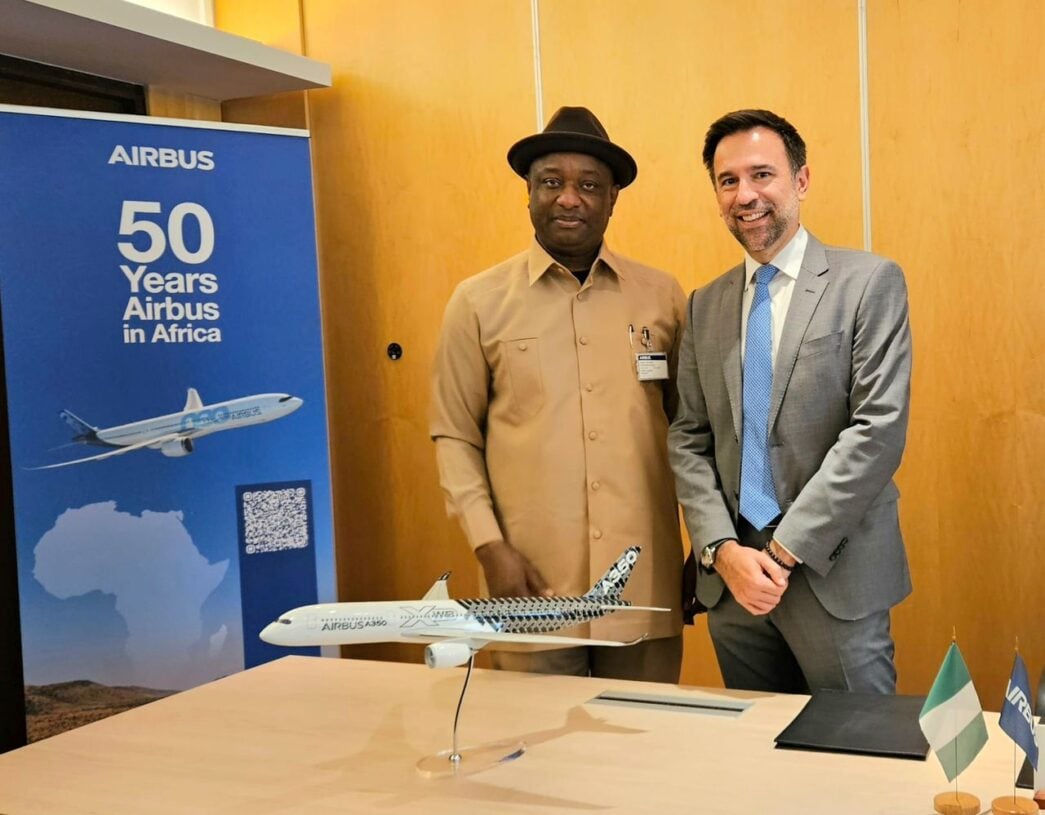
The agreement, formalised through a Memorandum of Understanding, was signed during a working visit by the Minister of Aviation and Aerospace Development, Festus Keyamo, to Airbus headquarters in Toulouse. The minister was accompanied by senior officials from key aviation institutions, including the Nigerian Civil Aviation Authority and the Nigerian Airspace Management Agency, underscoring the broad institutional backing for the initiative.
Keyamo described the agreement as a major step toward building a sustainable and globally competitive aviation ecosystem, noting that the collaboration aligns with the government’s broader ambition to expand capacity across all segments of the industry. He said the partnership would not only address infrastructure gaps but also drive knowledge transfer and strengthen technical capabilities within the sector.
Under the terms of the MoU, Airbus will provide support in critical areas such as aviation infrastructure development, pilot and engineer training, and advisory services on Maintenance, Repair and Overhaul operations. The agreement also includes provisions for aviation market intelligence and technical assistance designed to improve operational efficiency and long-term planning.
Speaking on the partnership, Airbus President for Africa and the Middle East, Gabriel Semelas, described Nigeria as central to the continent’s aviation growth, citing its large population and expanding economy as key drivers of future demand. He noted that the collaboration reflects a shared commitment to scaling Nigeria’s aviation ecosystem while building local talent and institutional capacity.
Beyond traditional aviation services, the partnership will explore opportunities in Sustainable Aviation Fuel development, positioning Nigeria within the global shift toward greener and more efficient air transport systems. Expanded training programmes for aviation professionals are also expected to play a central role in addressing skill shortages across the industry.
Airbus projections indicate that Africa will require approximately 1,490 new passenger and cargo aircraft by 2044, alongside more than 20,000 pilots, 20,000 maintenance engineers and 21,000 cabin crew to meet growing air travel demand. Officials say the new agreement is designed to help Nigeria capture a significant share of this growth while strengthening its position as a regional aviation hub.
The deal is also expected to support job creation, enhance technical expertise and improve the overall competitiveness of Nigeria’s aviation sector as it seeks to align with global standards and expand its footprint within Africa’s rapidly evolving air transport market.