








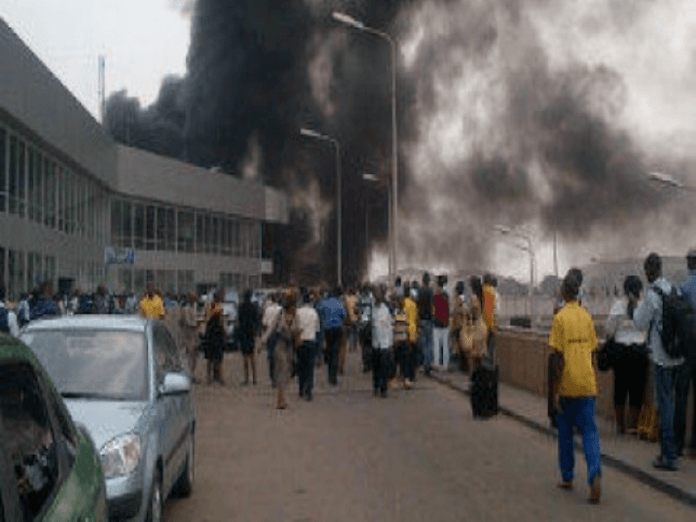
Flight operations have resumed in Lagos after a fire outbreak at the old terminal of Murtala Muhammed International Airport (MMIA) forced a temporary closure of the city’s airspace on Monday.
The blaze, which affected the section of the facility currently undergoing renovation, triggered an emergency response that led to the suspension of flight arrivals and departures earlier in the day. Aviation sources confirmed that the Lagos airspace was briefly shut, preventing international flights from landing or taking off while safety assessments were conducted.
At the height of the incident, about 10 people were reported trapped on the sixth floor of the airport’s control tower. However, authorities later confirmed that all air traffic controllers were safely evacuated after ensuring orderly management of aircraft within the affected airspace. No casualties were recorded.
Firefighters battled thick smoke and intense flames for several hours as rescue efforts continued within the tower. Officials said visibility was significantly reduced due to heavy smoke, complicating evacuation and containment efforts. A helicopter was observed hovering around the airport vicinity during the emergency response, although it was not officially confirmed whether it played any direct role in rescue operations.
The cause of the fire has not yet been officially determined, but preliminary suspicions point to a possible electrical fault. Investigations are ongoing to ascertain the exact source of the blaze.
Following containment of the fire and safety clearance by relevant authorities, flight operations gradually resumed and the Lagos airspace was reopened. Airport officials assured the public that measures were taken to prioritise passenger safety and restore normalcy as quickly as possible.
The incident recalls a similar fire outbreak on September 6, 2023, when smoke was detected at Terminal 1 of the airport. At the time, the Federal Airports Authority of Nigeria (FAAN) attributed the incident to a suspected electrical spark in the baggage hall ceiling, later traced to a burning lithium inverter battery in the basement.
Monday’s disruption once again highlights the vulnerability of critical airport infrastructure to fire-related incidents and underscores the importance of rapid emergency coordination to safeguard both passengers and aviation personnel.