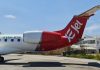








The Senate has rejected proposals to revive the controversial Nigeria Air project, describing further efforts to salvage the initiative as unproductive, while calling on the Federal Government to pursue a fresh approach to establishing a national carrier.
The position followed deliberations on a motion sponsored by Senator Mohammed Tahir Monguno, representing Borno North, which primarily sought stronger implementation and renegotiation of the Bilateral Air Services Agreement (BASA) between Nigeria and China to secure reciprocal flight rights for Nigerian airlines.
During Tuesday’s plenary, Senate President Godswill Akpabio said Nigeria needed a strong indigenous airline capable of competing in the international market. However, the Senate ruled out revisiting the existing Nigeria Air project, which was initiated under former Aviation Minister Hadi Sirika during the administration of former President Muhammadu Buhari.
Lawmakers maintained that the country still required a functional national carrier but urged the Ministry of Aviation and Aerospace Development to explore fresh options rather than attempt to revive the failed project.
The debate also focused on concerns that Nigeria’s aviation relationship with China had not delivered sufficient opportunities for domestic operators, despite the growing economic ties between both countries.
Monguno recalled that Nigeria and China had signed a BASA under the Buhari administration to establish direct commercial air links and regulate flight operations between the two countries. He, however, expressed concern that the agreement had not been effectively implemented to guarantee reciprocal benefits for Nigerian airlines.
He called on the Federal Ministry of Aviation and Aerospace Development, the Nigerian Civil Aviation Authority, the Central Bank of Nigeria and the Nigeria Customs Service to work together to ensure that Nigerian carriers obtain the necessary approvals and operational clearances to fly directly to China.
Monguno argued that improved air connectivity would reduce travel time, strengthen trade and supply chains, increase airline revenues and help retain foreign exchange within the country. He also highlighted opportunities for small and medium-scale businesses and non-oil exporters, particularly those involved in agricultural trade.
Contributing to the debate, Senator Abdul Ahmed Ningi, representing Bauchi Central, supported the motion but called for stronger reciprocity in Nigeria’s aviation and economic relations with China.
He questioned why Chinese airlines should continue enjoying access to the Nigerian market without Nigerian carriers receiving equivalent opportunities to operate direct routes. Ningi noted that Nigerians travelling to China often had to connect through other countries, including the United Arab Emirates, Ethiopia, Morocco and the United Kingdom.
He identified Air Peace, United Nigeria Airlines, Azman Air and Ibom Air as indigenous operators that could be encouraged to pursue direct services to China, subject to regulatory and operational requirements. He urged the Federal Government to review the agreement if reciprocal flight rights could not be secured.
Ningi also raised concerns about the activities of Chinese nationals in Nigeria’s solid minerals sector, calling for stronger government oversight to ensure that mining operations comply with relevant laws and deliver greater economic benefits to the country.
Akpabio, while expressing support for the establishment of a national airline, recalled the operations of the defunct Nigerian Airways and argued that Nigeria needed a strong domestic carrier to improve international connectivity, retain foreign exchange and ease pressure on existing airlines during peak travel periods.
Other lawmakers, including Senator Mustapha Khabeeb and Senator Mohammed Ogoshi, also supported the call for a national carrier and stronger reciprocal arrangements under the Nigeria-China aviation agreement.
Following the debate, the Senate adopted the motion and urged the Ministry of Aviation and Aerospace Development to renegotiate the commercial terms and operational schedules of the existing BASA with China.
It also called on the Ministry of Foreign Affairs to initiate diplomatic discussions with Chinese authorities to facilitate business visas for Nigerian traders and secure reciprocal allocation of flight slots for Nigerian airlines.
The Senate further directed its Committees on Aviation and Foreign Affairs to monitor implementation of the resolutions and report back within four weeks.