










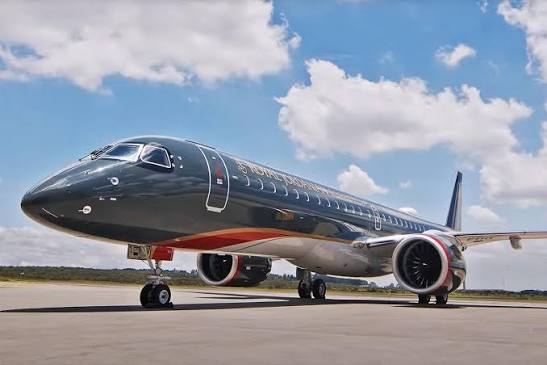
Brazilian aircraft manufacturer Embraer has projected global demand for 8,500 new commercial jets valued at approximately $650 billion over the next 20 years, with Africa expected to rank among the world’s fastest-growing air travel markets.
The forecast is contained in the company’s Market Outlook 2026, released ahead of the Farnborough Air Show. The report focuses on commercial aircraft with fewer than 150 seats and examines the long-term trends expected to shape airline fleet requirements through 2045.
According to Embraer, global passenger traffic, measured in Revenue Passenger Kilometres (RPK), is expected to grow at an average annual rate of 3.7 percent over the forecast period, driven by expanding regional economies, growing tourism and stronger air connectivity.
China is projected to record the fastest passenger traffic growth at 5.2 percent annually, followed by the Middle East at 4.6 percent. Africa ranks third with projected annual growth of 4.4 percent, ahead of Latin America and the Caribbean (4.3 percent), Asia-Pacific (4.1 percent), Europe (2.7 percent) and North America (2.0 percent).
By 2045, Asia-Pacific and China are expected to account for about 40 percent of global passenger traffic, while Europe and North America will jointly represent 37 percent.
Despite Africa’s strong traffic growth outlook, the continent is forecast to account for 370 aircraft deliveries, representing about four percent of the projected global demand. North America is expected to remain the largest market for new aircraft with 2,670 deliveries, followed by Europe and the CIS with 1,870 aircraft, China with 1,470, Asia-Pacific with 1,050, Latin America with 740 and the Middle East with 330.
Embraer President and Chief Executive Officer of Commercial Aviation, Arjan Meijer, said changing global economic patterns would reshape future airline networks and create stronger demand for regional aircraft.
According to him, the expansion of advanced manufacturing hubs and regional supply chains is increasing the need for efficient, high-frequency air links between emerging economic centres, while changing consumer travel preferences are encouraging airlines to strengthen connectivity to smaller cities using sub-150-seat aircraft.
The report also notes that these market shifts, combined with continued fleet modernisation and the growing demand for fuel-efficient aircraft, will drive long-term investment in regional aviation and support sustained demand for next-generation commercial jets through 2045.