









The Nigerian Aviation Handling Company Plc (NAHCO Aviance) and the Nigerian Association of Chambers of Commerce, Industry, Mines and Agriculture (NACCIMA) have strengthened collaboration aimed at positioning small and medium-scale enterprises (SMEs) as key drivers of Nigeria’s non-oil export growth through improved air cargo processing.
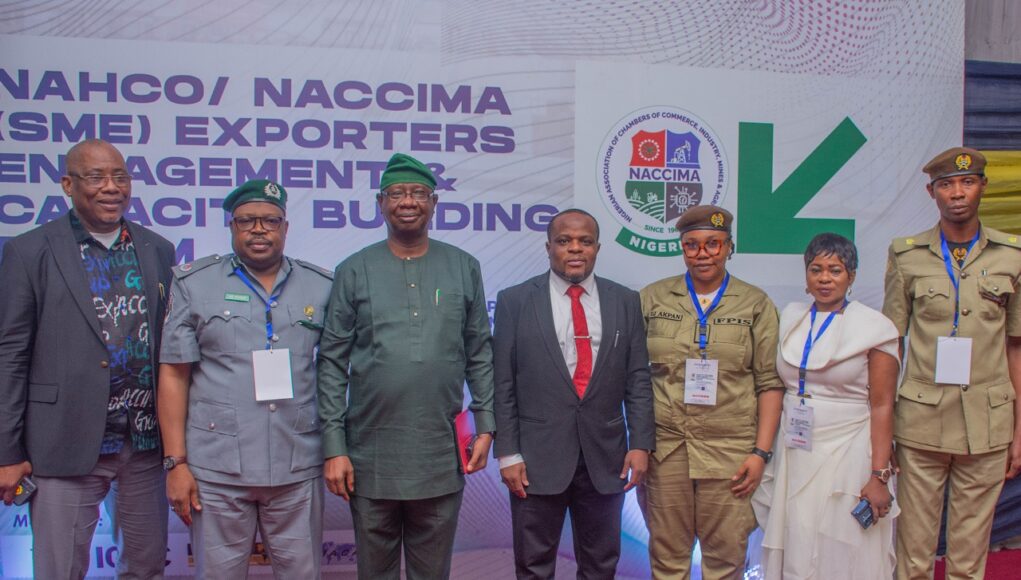
The renewed partnership was highlighted at a capacity-building forum on export processing held in Lagos, which brought together exporters, regulators, airlines, logistics providers and financial institutions to address persistent bottlenecks limiting Nigeria’s export competitiveness.
Speaking at the forum, NAHCO’s Group Executive Director, Business and Business Development, Prince Saheed Lasisi, said the company’s export strategy is aligned with the Federal Government’s ambition of achieving a one-trillion-dollar economy by 2030, with commodity exports playing a central role.
“To achieve the volume of commodity exports Nigeria needs, SMEs must be actively involved,” Lasisi said. “But participation alone is not enough. SMEs must build the right capacity in export processing, logistics and compliance.”
He noted that many Nigerian exports fail to reach international markets due to shortcomings in packaging, handling, documentation and cold-chain management, stressing that export losses often occur before cargo even gets on an aircraft.
According to him, NAHCO occupies a strategic position in the export value chain, serving as the operational link between exporters, airlines and regulators. In this role, the company provides guidance on cargo acceptance standards, regulatory compliance, product preservation and flight connectivity requirements demanded by international buyers.
As part of efforts to close critical gaps, Lasisi highlighted NAHCO’s investment in dedicated export infrastructure, including the NAHCO Export Packaging and Processing Centre (NEPPC), located within the airport environment and approved by the Federal Airports Authority of Nigeria (FAAN).
“The NEPPC is the only specialised export packaging facility of its kind in Nigeria,” he said. “It became operational in July last year and is designed to support proper packaging of perishables and sensitive cargo, reduce rejection rates and improve export reliability.”
He added that NAHCO’s Export Desk also provides hands-on support to SMEs, particularly first-time exporters navigating complex international trade requirements.
On his part, Chairman of the NACCIMA Export Group, Kola Awe Esq., said the association has intensified initiatives to help MSMEs overcome export-related constraints. He cited the establishment of the NACCIMA Export Support Centre for MSMEs as a targeted intervention to improve export readiness and scalability.
“Many small exporters struggle not because they lack products, but because they lack the capacity to manage risks, logistics and compliance,” Awe said. “Multinationals can absorb these challenges more easily, but MSMEs need structured support.”
In his welcome remarks, NACCIMA Director General, Engr. Sola Obadimu, said the collaboration with NAHCO underscores the importance of private-sector partnerships in expanding Nigeria’s agro-based exports. He noted that while MSMEs account for up to 90 per cent of businesses and over 80 per cent of employment in Nigeria, their contribution to exports remains disproportionately low.
“Agriculture contributes more than 20 per cent to Nigeria’s GDP, yet agro-exports still account for only a modest share of our export earnings,” Obadimu said. “This gap is largely due to procedural bottlenecks, weak export readiness and logistics challenges.”
Also speaking, Head of Commercial Banking at Polaris Bank, Mrs. Ladi Ene Garba, warned that Nigeria’s heavy dependence on crude oil for foreign exchange exposes the economy to global shocks. She said expanding non-oil exports, particularly through SMEs, is critical to economic resilience.
President of the Aviation Cargo Committee, Mr. Ikechi Uko, emphasised the strategic role of air logistics, noting that many aircraft arrive Nigeria full but depart with little or no export cargo. According to him, improved export processing would allow Nigeria to better utilise outbound air cargo capacity.
The forum featured participation from key export-related agencies including the Nigeria Customs Service, Nigeria Agricultural Quarantine Service, National Agency for Food and Drug Administration and Control (NAFDAC), Nigerian Export Promotion Council (NEPC) and FAAN, alongside international airlines and logistics firms.
Both NAHCO and NACCIMA said the engagement marks a step toward building a more structured, efficient and SME-friendly export ecosystem capable of increasing Nigeria’s share of global trade and strengthening non-oil revenue generation.