
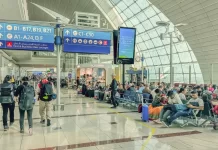







Saudi Airlines has come under intense public and regulatory scrutiny after leaving 401 Kano-bound passengers stranded at the Nnamdi Azikiwe International Airport, Abuja, for almost 48 hours, a situation that escalated into tension and raised serious security concerns.
The Nigerian Civil Aviation Authority (NCAA) confirmed that the disruption initially stemmed from bad weather conditions in Kano, which forced the Saudi Airlines flight to divert to Abuja. However, the regulator faulted the airline for failing to make adequate arrangements to transport passengers to their final destination, a lapse that it described as poor passenger handling.
The incident was disclosed in a statement issued on Monday by the NCAA’s Director of Public Affairs and Consumer Protection, Michael Achimugu, via his verified X handle. Achimugu revealed that he personally intervened to de-escalate the situation after reports of possible violence from frustrated passengers.
Describing the episode as one of the most intense moments of his professional career, Achimugu said he had to abandon personal plans after receiving credible intelligence about threats of extreme violence at the airport.
“Yesterday, I had to make a U-turn while heading to my barber’s shop after receiving reports of a valid threat of extreme violence from stranded Saudi Airlines passengers in Abuja,” he said.
According to Achimugu, several airlines were affected by the same weather conditions and also diverted their flights to Abuja. However, unlike Saudi Airlines, those carriers reportedly made alternative arrangements for their passengers. Saudi Airlines, he said, returned to its base without ensuring that its passengers reached Kano.
He recounted standing among more than 200 visibly angry passengers who had waited for hours without clear information on when or how they would continue their journey.
“I stood amidst over 200 angry passengers, pacifying, reprimanding and resolving. This is the most adrenaline-rushing part of my job. It requires tact, firmness, wisdom and teamwork. But it is risky. Some passengers are extremely violent,” Achimugu said.
At the peak of the crisis, Achimugu disclosed that one irate passenger threatened to physically assault him. He said the confrontation was diffused through dialogue and empathy, turning a potentially violent encounter into a peaceful resolution.
While acknowledging that Saudi Airlines does not maintain an operational base in Abuja—a factor that complicated logistics—the NCAA insisted that the situation could have been handled far more professionally and in line with Nigeria’s consumer protection regulations.
Achimugu further disclosed that he met with the Saudi Ambassador to Nigeria, where he made it clear that no airline would be allowed to operate in the country in disregard of Nigerian aviation and consumer protection laws.
He commended the intervention of the Federal Airports Authority of Nigeria (FAAN), particularly the Regional General Manager, noting that stranded passengers were eventually airlifted to Kano in batches by UMZA Aviation.
According to him, the first aircraft conveyed 74 passengers and four crew members, the second transported 73 passengers with four crew members, while the third and final flight carried 34 passengers. In total, 189 passengers were successfully transported to Kano.
The NCAA also revealed that Saudi Airlines has committed to compensating the affected passengers.
“This brings to an end a disruption of almost 48 hours that began as force majeure, transitioned into poor passenger handling, and ended with a strong display of effective teamwork—from the Minister to the DGCA and down to our hardworking Consumer Protection Officers,” Achimugu said.
Efforts to obtain a response from Saudi Airlines proved unsuccessful, as the airline is neither domiciled in Nigeria nor operates an information office in the country. Emails sent to the airline had not been acknowledged as of the time of filing this report.