






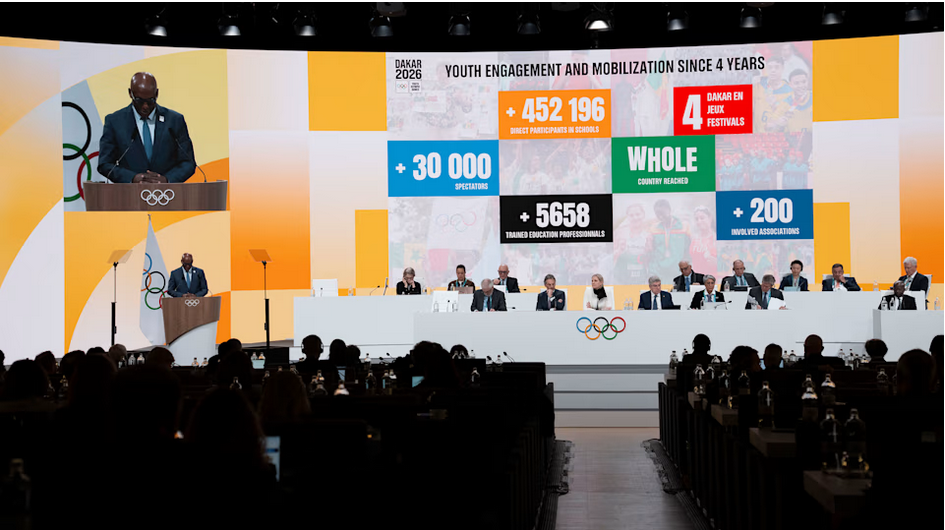
Momentum is building steadily across Senegal as preparations for the Dakar 2026 Youth Olympic Games move decisively from planning into full delivery mode. With the Games year now underway, organisers say progress is becoming increasingly visible on the ground, signalling growing readiness less than a year before the Opening Ceremony.
An update presented to the 145th International Olympic Committee (IOC) Session confirmed that Dakar 2026 has entered a critical phase, with venue works, operational planning and governance structures advancing in tandem. The briefing was delivered by President of the Dakar 2026 Organising Committee (YOGOC), Mamadou Diagna Ndiaye, and General Coordinator Ibrahima Wade, marking a clear transition from strategy to execution. Coordination Commission Chair Humphrey Kayange also addressed IOC Members, commending the tangible momentum while stressing that priorities would continue to be closely monitored and systematically addressed.
As Games year begins, confidence is being driven by measurable progress across competition and non-competition venues. Several sites have already hosted operational testing, while ongoing renovations are being designed with a strong post-Games legacy in mind, particularly to ensure long-term access for young athletes. The Youth Olympic Village, a central element of the Games, is set to be converted into student accommodation after the event. International Sports Federations remain closely involved in the preparations through regular site visits and virtual engagements, with the Chefs de Mission Seminar scheduled for April standing out as a major upcoming operational milestone.
National coordination around Dakar 2026 has also intensified. Senegalese President Bassirou Diomaye Faye has taken a visible role in the preparations, attending the One-Year-To-Go celebrations and maintaining close engagement with the Organising Committee. Ndiaye told IOC Members that the Games are now just 270 days away, noting that delivery efforts are supported by strengthened governance and a robust monitoring framework developed jointly with the IOC and key Games delivery partners.
Public enthusiasm for Dakar 2026 continues to grow, fuelled by high-profile celebrations and community-focused events. The One-Year-To-Go milestone and the fourth edition of the Dakar en Jeux festival have played a significant role in driving engagement, with the latter featuring an international futsal competition and welcoming representatives from 42 National Olympic Committees across five continents. In central Dakar, the newly installed Dakar 2026 OMEGA countdown clock has become a daily symbol of the approaching Games, reinforcing public awareness and anticipation.
Beyond the immediate preparations, organisers continue to emphasise the long-term impact of Dakar 2026 for young people in Senegal and across Africa. The Dakar 2026 Learning Academy is already delivering on this ambition, with nearly half of its 400 available places filled by participants from 25 African National Olympic Committees who will join the Organising Committee and gain hands-on Games-time experience. This focus on capacity-building is complemented by Jambaar26, the volunteer programme launched in December, which aims to mobilise 6,000 volunteers nationwide.
Looking ahead, Kayange highlighted the significance of the Olympic flame’s arrival on African soil in September as a defining moment for the continent. The flame will embark on a nationwide tour across Senegal’s 14 regions, accompanied by local celebrations and supported by Olympic Solidarity, serving as a unifying symbol for communities and African nations alike. He noted that beyond infrastructure and accommodation, Dakar 2026 will leave a formidable legacy in the form of trained young human capital across Africa.
The Dakar 2026 Youth Olympic Games will take place from 31 October to 13 November 2026, welcoming around 2,700 athletes aged 17 and under to compete across three host zones: Dakar, Diamniadio and Saly.